The toolbox is optional, the wordlists are local, and OSINT is explicit-query only. None of the three starts on its own: something you or the agent asked for has to trigger it, and every trigger passes the same scope and RoE gates.
The Kali container
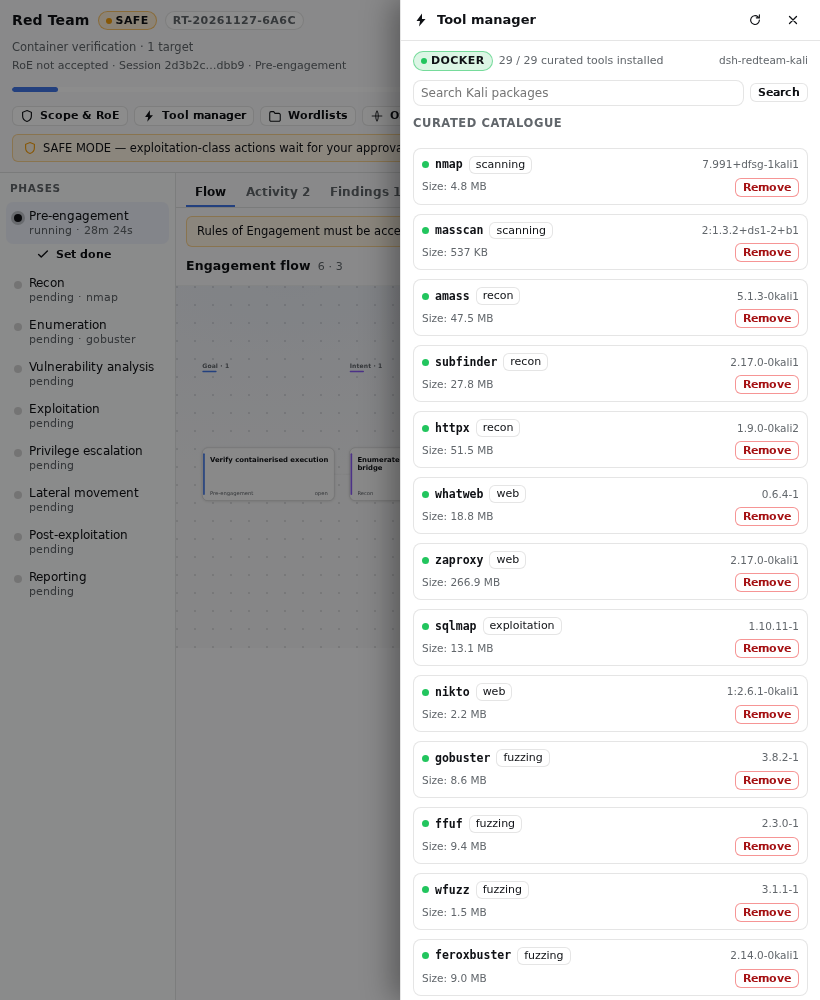
The controller owns one container, dsh-redteam-kali, built from kalilinux/kali-rolling and labelled dsh.redteam=1. It is created on demand, with --restart unless-stopped, and is never recreated implicitly; an explicit setup action is what creates or replaces it. Containers without the label are never deleted by the plugin.
| Control | Default | Effect |
|---|---|---|
| Capabilities | --cap-drop ALL, then add back NET_RAW, NET_ADMIN, CHOWN, DAC_OVERRIDE, FOWNER, FSETID, SETGID, SETUID, MKNOD | Raw-socket tools work; the rest is what apt/dpkg needs; never --privileged |
| Privilege escalation | no-new-privileges | Processes cannot gain privileges after start |
| Init and PIDs | --init, --pids-limit 2048 | Orphans are reaped; a fork bomb cannot exhaust the Host |
| Limits | Memory and CPUs unset, extra tmpfs empty | Optional memory, cpus and tmpfs are validated before Docker sees them |
| Catalogue | 47 entries | Operator name, apt package, real binary, version probe and category |
Those 47 entries were counted from lib/host/kali.js on 27 November 2026. The inventory reports installed state, version and the active runtime. A catalogue name is not always the binary name: metasploit-framework runs msfconsole, searchsploit comes from exploitdb, certipy is packaged as certipy-ad, and rpcclient ships inside smbclient.
pentest_setup_toolbox()
pentest_tool_inventory({ refresh: true })
pentest_install_tool({ package: "nuclei" })
pentest_tool_search({ query: "graphql" })
pentest_setup_toolbox is idempotent: it pulls the image when absent, creates the hardened container, runs apt-get update and syncs the bundled wordlists. Installing the first tool does the same automatically. Installs and removals run inside the container only, and a package search queries the container's apt index.
Degraded host mode
When Docker is unreachable, the executor falls back to binaries already on the DSH user's PATH if allowHostFallback is true (the default). The Tool Manager badge reads HOST, the snapshot reports why Docker failed, and every run records runtime: "host". If neither Docker nor a usable host executor exists, the badge reads UNAVAILABLE.
Installation and removal never fall back. There is no code path that runs apt on the host, so a missing package in host mode stays missing. Set allowHostFallback: false when you want execution to fail closed with docker-unavailable instead of using host binaries. In Docker mode, a target of localhost, 127.0.0.0/8 or ::1 is refused before execution, because it would address the container rather than the Host.
Wordlists and resolution
Bundled lists, uploads and AI-generated lists share one registry. The build ships 12 bundled lists, counted from wordlists/manifest.json on 27 November 2026: three directory lists, one DNS list, two password lists, one username list, one LFI list, one SQLi list, one XSS list, one API list and one Active Directory list.
pentest_wordlists()
pentest_resolve_wordlist({
  id: "dir-medium",
  tool: "gobuster"
})
Resolution is the important part. pentest_resolve_wordlist accepts an id, a category or an alias and returns the path the active runtime can actually read: a container path under /opt/redteam/wordlists in Docker mode, a host path otherwise. It also applies tool affinity, so a broad gobuster request resolves to the compact common list while ffuf gets the larger RAFT subset. Never hard-code either path form into a command.
Uploads are .txt files capped at 32 MiB, filed under a category, with a preview of the first lines. A new list is written under $DSH_HOME/redteam/wordlists/ and synced to the container on the next setup or enhancement.
AI wordlist enhancement
pentest_enhance_wordlist asks the Host model route for candidates and saves them as a new source:"ai" list. You can start from a base list (listId) or a category, give a count, and add an instruction such as "PHP admin panels, backups, API v2". Counts are 20–1000, default 200, capped by aiEnhancement.maxCandidates (300 by default).
Engagement context — target, technologies, observedPaths — is sent only when the operator enables allowRemoteContext or the call passes consent: true. Without that, only the category and instruction leave the Host. Credential-shaped values are redacted before the prompt is built. The reply is parsed as strict JSON, validated per category, deduplicated against the base list and every existing AI list, and written as a new list.
pentest_enhance_wordlist({
  category: "api",
  count: 120,
  instruction: "Undocumented v2 endpoints and debug routes",
  consent: false
})
Two follow-ups close the loop. pentest_wordlist_feedback records hits and misses against a list, biasing later generation. pentest_wordlist_adapt derives variants from real gobuster, ffuf or nmap output, or from explicit hits, and works without a model route; the result states which mode produced it. If no model is configured, the enhancement panel reports disabled, no-llm or no-model, and the bundled and uploaded lists keep working.
OSINT connectors and gates
pentest_osint runs one explicit lookup at a time: service and query, where the query is an IP, domain, email, organisation or keyword depending on the connector. There are 39 connectors in the catalogue, counted from lib/host/osint.js on 28 November 2026. Results become fact nodes (at most 12 per lookup). A service without a key returns an explicit not-configured error rather than a guess.
Passive enrichment. pentest_osint_enrich takes one in-scope target — IP, CIDR, domain or hostname — plus an optional maxHosts and phase. It combines the connectors into a report-ready model: ASN and announced prefix, country/city, ISP/organisation, reverse DNS, observed hostnames, related domains, certificate-transparency subdomains, third-party port observations, CVE ids, reputation signals, a per-source record with timestamps, a fieldSources provenance map, a heuristic confidence with its basis, and an explicit limitations list. It is passive by construction: it never scans, never opens a connection to the target and never invents a value a source did not return. A CIDR is sampled to 16 addresses by default (256 hard) and IPv6 blocks wider than /120 are refused. The results land in the OSINT tab and in the fact graph.
Keys resolve in four layers, first hit wins: the DSH credential service, the process environment, $DSH_HOME/osint-keys.env (0600), then the plugin row's keys object. The drawer writes through the credential service when available and reports only configured plus the source; the value is never returned to the page, tool output, audit trail or report. Services needing two credentials accept first:second in one field.
| Gate | Default | What it changes |
|---|---|---|
osint.osintAllowlist | [] | When non-empty, a query must match a scoped domain, IP or email domain |
osint.approveLeakLookups | false | Leak connectors return leak-approval-required until enabled after written authorization |
osint.leakBudgetPerHour | 20 | Hard hourly cap on breach/leak lookups; 0 disables the cap |
osint.darkwebBudgetPerHour | 10 | Hourly cap on Ahmia, Tor-status and onion lookups |
osint.enableOnionFetch | false | Allows one explicit .onion URL through a loopback Tor SOCKS proxy; remote proxies are refused |
| Policy refusal | always on | Illegal query categories are rejected locally with policy-blocked before any request |
Leak results keep counts, source names and non-credential field names only: no plaintext passwords, hashes, tokens or leaked email addresses. Audit events use a salted subject hash rather than the query. A 404 or empty result is not proof of absence — HIBP can return 404 for an unverified domain, and each index covers only its own corpus.
dsh-redteam-kali, never on the host.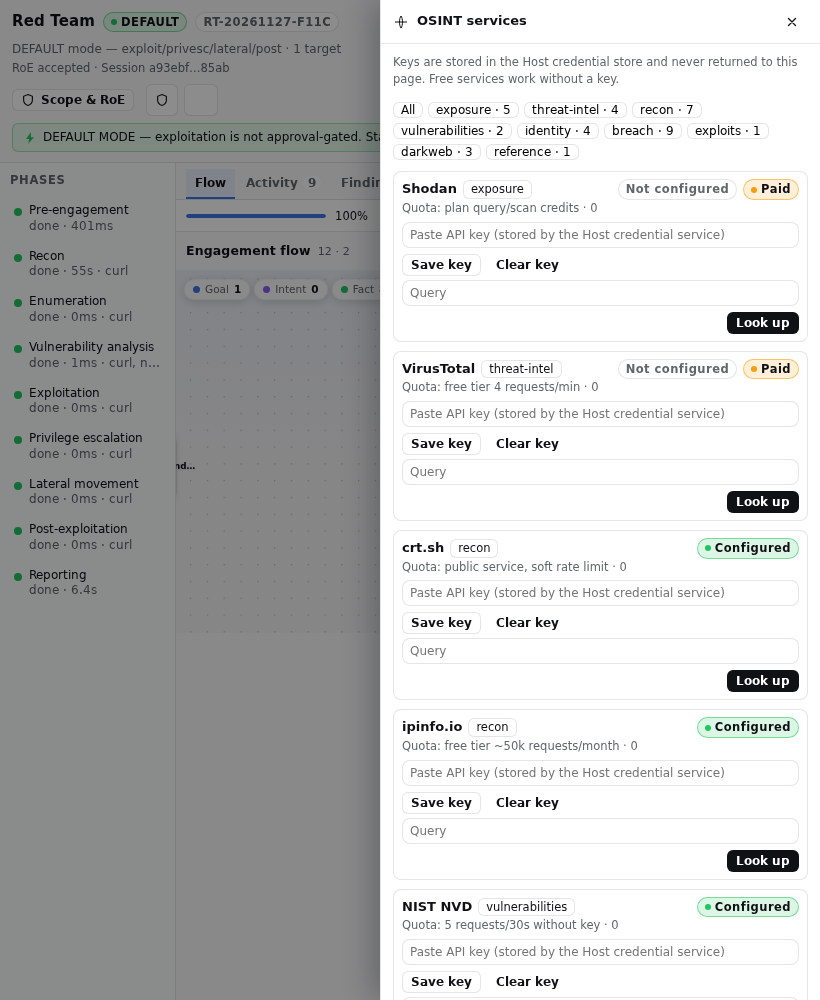
Breach records are personal data under GDPR, CCPA and similar regimes. Obtain written authorization and legal sign-off before enabling approveLeakLookups or onion fetch, collect only what the engagement needs, prefer counts and metadata, and delete raw responses when the report is done. The plugin enforces approval, allowlists and budgets; it does not decide whether the lookup is lawful.
What leaves the machine is narrow: the query goes to the third-party service, nothing else is attached, and there is no telemetry. Keys, the engagement document, the graph and the evidence never travel with an OSINT request.
The OSINT tab and the standalone report. The eighth tab is a read-only board over the stored results: one row per IP, CIDR, domain or hostname with its kind, identity fields, reputation, sources, timestamp, confidence and the graph nodes it connects to. It starts no lookup. From there or from the agent, pentest_osint_report writes a standalone Markdown, HTML or JSON brief (formats, title, basename) from stored facts and enrichment models only. It makes no network or DNS call, uses stored timestamps and sorted rows, escapes every dynamic value, scrubs keys and tokens, and never overwrites an existing file. It is separate from the six engagement report formats and is not embedded in the main report — write it beside the report, not instead of it.
Playbooks
pentest_skills exposes 20 curated playbooks grounded in PTES, OWASP WSTG and MITRE ATT&CK. Each carries an objective, when to use it, prerequisites, bounded steps, tools, required evidence, stop conditions, ATT&CK and WSTG references, validation and safety notes. The library is advisory: it never executes a tool, writes a finding or creates evidence.
pentest_skills({ action: "recommend" })
pentest_skills({ action: "list", phase: "vulnerability-analysis", category: "api" })
pentest_skills({ action: "get", id: "api-authorization-matrix" })
The 20 were counted from the shipped registry on 27 November 2026. recommend ranks three to eight skills from the running or next phase, asset and API hints, findings and evidence; list filters by phase, category, tag, query or limit; get returns one full playbook. Use them to structure a phase, then run the real tools through pentest_exec so the evidence chain stays intact.
Next: web and API testing. Deeper: OSINT.md, SKILLS.md, the tool reference and the resource catalogue.
What good looks like
- The Kali container is optional, hardened and plugin-owned; installs and removals never touch the host.
- Host mode is a labelled degradation, not a silent fallback: install and remove are refused, and the runtime is recorded on every run.
- Resolve wordlists per runtime with pentest_resolve_wordlist; never hard-code a container or host path.
- AI wordlist context needs consent, and generated candidates are validated, deduplicated and saved as a new list before use.
- OSINT is one explicit query at a time; keys stay on the Host, leak and dark-web lookups are gated, and metadata-only results are the default.