Live attack graph
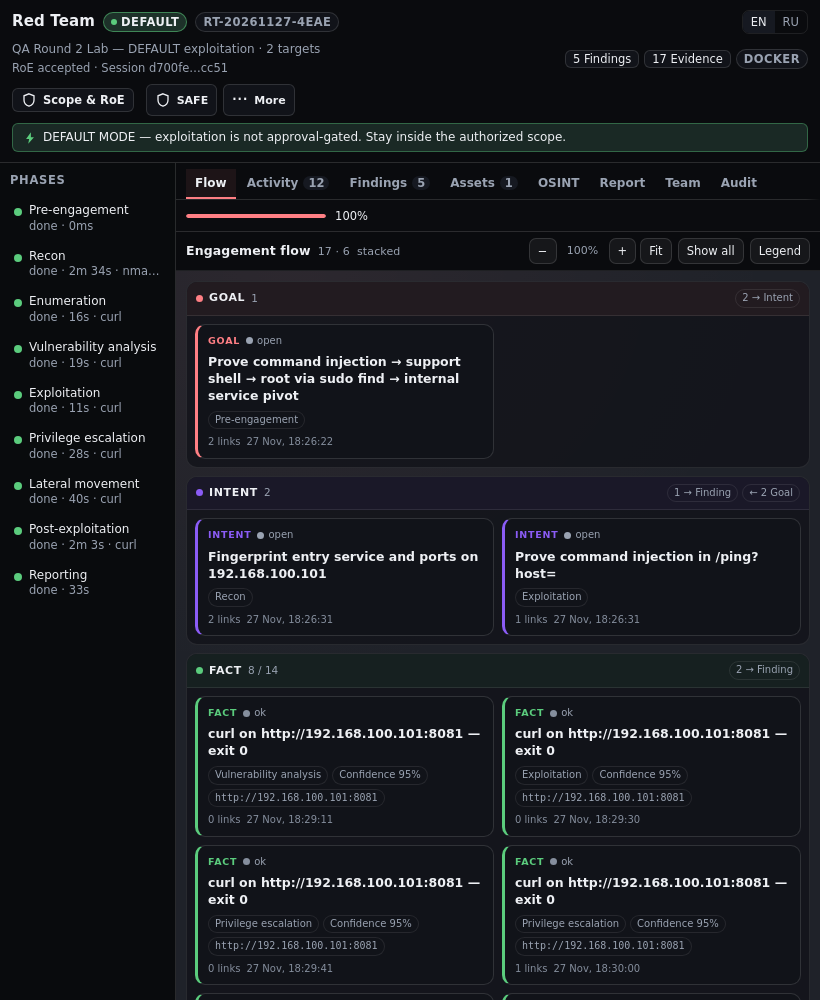
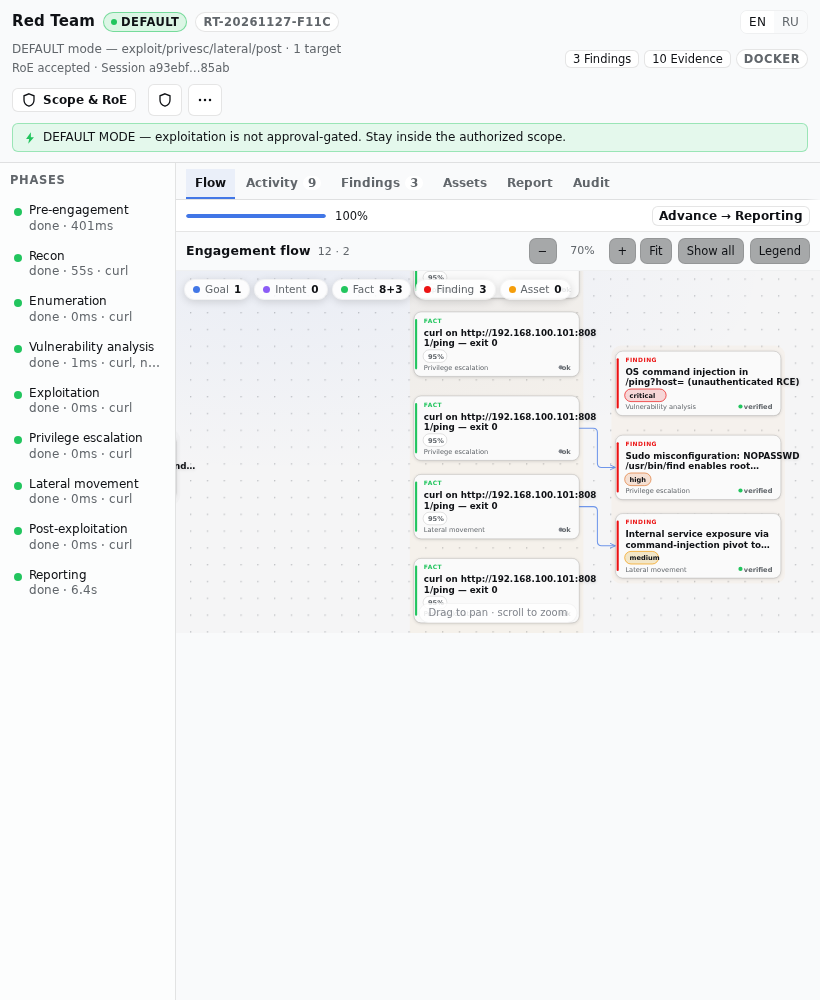
Goal → Intent → Fact → Finding → Asset with labelled edges, phase filters, a target-topology view in Assets, and an inspector that shows the raw tool run behind any node.
DeepSeek Harness plugin
A PTES workbench that lives in the sidebar: an agent with 51 tools, passive OSINT enrichment and a report of its own, a live goal-to-finding graph, plan and team mode, a hardened Kali toolbox, real browser and API testing, and an evidence chain an auditor will accept.
$ git clone https://github.com/sm0k3net/dsh-redteam.git
$ cd dsh-redteam
$ dsh plugin --profile web add "$PWD"
The problem
No scope, no evidence chain, no artefacts anyone would sign. This plugin makes the engagement the primary object — and keeps the human in the decisions that matter.
Capabilities
The agent's tools and your panel read and write the same engagement. Nothing it does is invisible; nothing you approve is unrecorded.
Goal → Intent → Fact → Finding → Asset with labelled edges, phase filters, a target-topology view in Assets, and an inspector that shows the raw tool run behind any node.
pentest_osint_enrich turns one in-scope IP, CIDR, domain or hostname into ASN, geography, PTR, hostnames, certificate subdomains, third-party ports, reputation, sources and confidence — without scanning or touching it. pentest_osint_report writes a standalone Markdown/HTML/JSON brief, and the new OSINT tab renders what was actually collected.
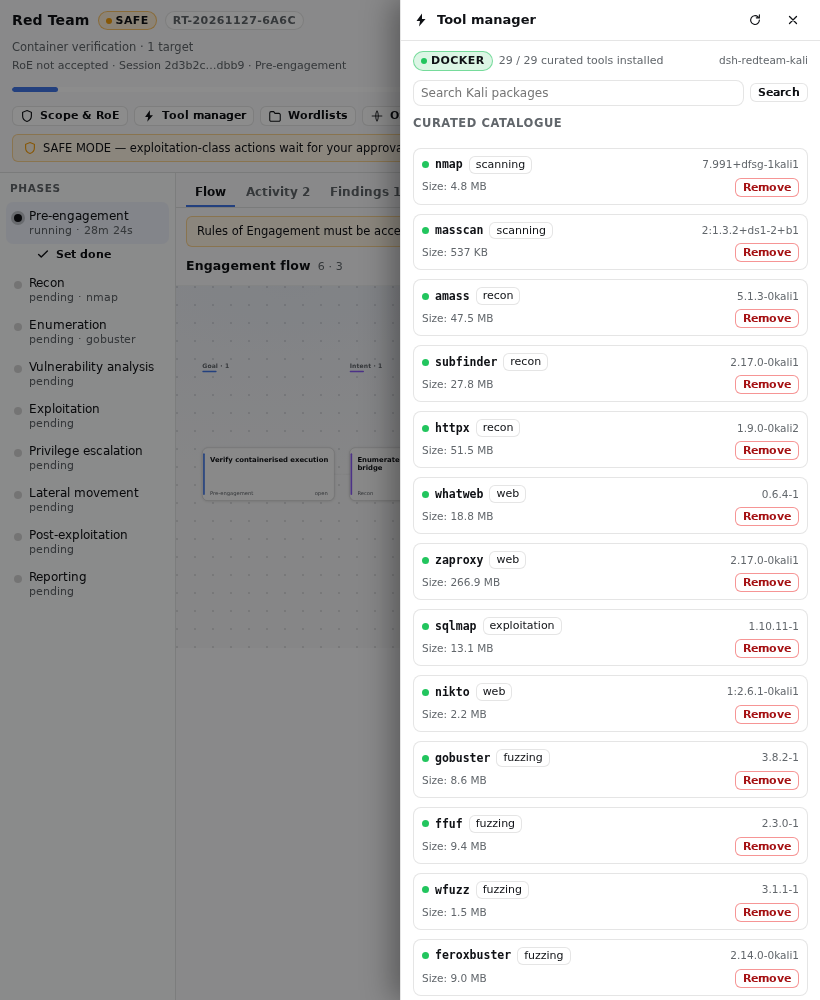
A plugin-owned container: all capabilities dropped, only the apt and raw-network ones added back, PID limits, no host apt, and a degraded host mode when Docker is absent.
Isolated Chromium per engagement: DOM and form snapshots, click, fill, evaluate, screenshots, cookies, storage, network and console — with scope enforced on navigation.
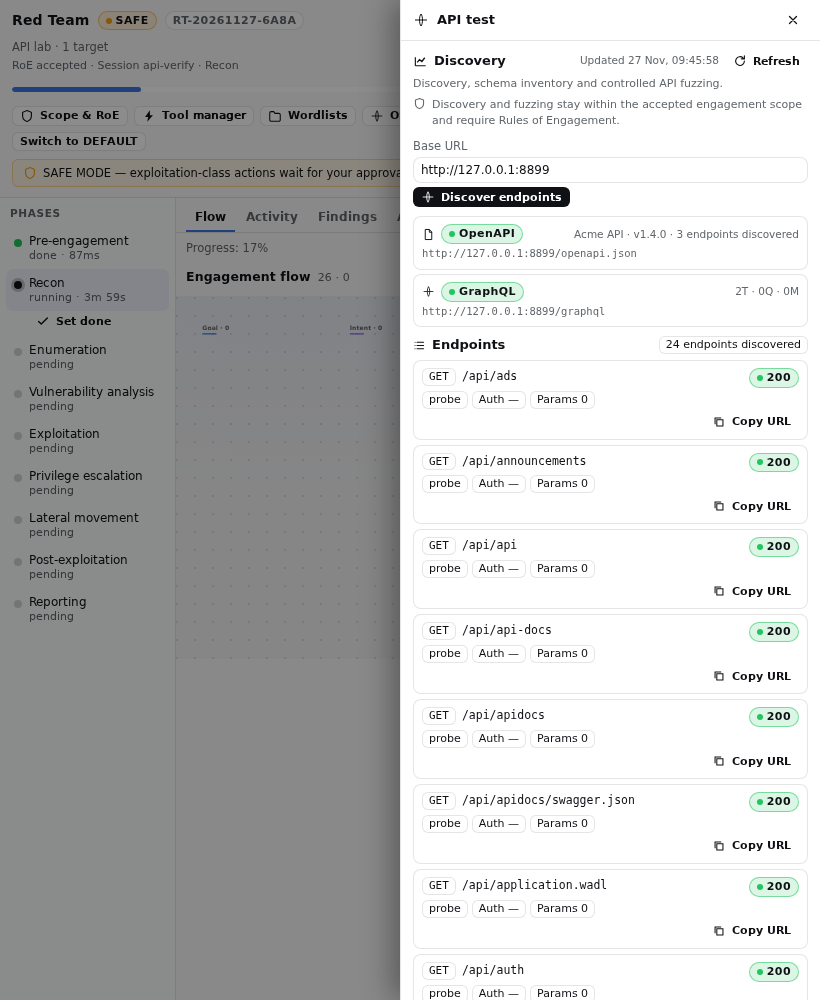
OpenAPI, GraphQL and JS-bundle mining, a scoped request console, nine payload families with rate limits and anomaly detection, plus scoped Nuclei template scans.
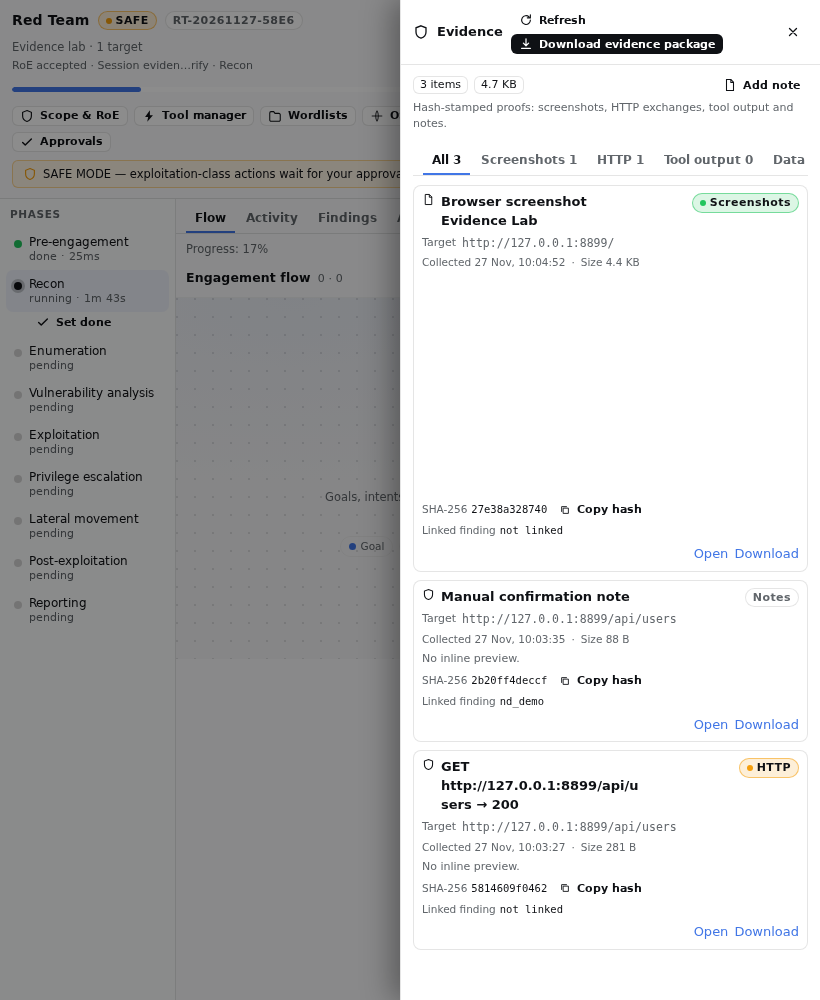
Every capture hashed with SHA-256, stored write-once, packaged with a manifest and sha256sums.txt, and listed in the report register. pentest_verify re-reads what was captured and returns confirmed, refuted or inconclusive.
Markdown, DOCX, self-contained HTML, JSON, PDF with embedded fonts and a slide outline — six formats, English and Russian. The HTML report is a findings-first brief: a verdict panel and severity mix lead, business issues link straight to their finding, and supporting analysis collapses on screen and expands for print.
20 auditable playbooks with phase, objective, steps, tools, evidence requirements and validated ATT&CK/WSTG references, reachable through pentest_skills.
pentest_exploitation plans candidates, records one least-impact attempt per round, classifies the real output, changes exactly one variable and either retries, pivots or confirms with linked evidence. Caps are enforced: 6 rounds by default (12 maximum), 3 attempts per candidate (5 maximum), 20 candidates.
Turn one operator description into validated targets, CIDRs and domains with credential redaction and metadata-endpoint refusal — a draft for review, never an auto-apply.
A recon or OSINT discovery can now extend the boundary through pentest_scope: inside an authorized target, CIDR or domain root it is applied automatically and audited with its source fact; outside every root it waits as a pending proposal only the operator can approve. Exclusions and metadata endpoints never expand, and the RoE acceptance is not reset.
pentest_export_bundle writes a deterministic ZIP: every report format, the evidence vault, findings CSV/JSON and SARIF 2.1.0, the engagement state, audit trail, tool runs and SHA-256 sums.
pentest_plan keeps a budgeted step plan with a deterministic critic that blocks on real conditions only; pentest_team turns selected roles into phase tasks with dependencies, write scopes and delegation prompts. Both surface in the new Team tab.
Stop kills active tool runs, interrupts tracked native agents, blocks the running phase and denies pending approvals while keeping findings, evidence and the audit trail. Restart from scratch archives the old state and artifacts, keeps scope and RoE, and starts a clean engagement with a new id.
pentest_identity records accounts, auth method, privileges and per-asset access, then computes the coverage and privilege gaps and the identity tests against each asset. Secrets are never stored — only whitelisted fields, with credential-shaped text redacted.
pentest_oob mints inert canary tokens for blind SSRF and XXE callbacks and records bounded, deduplicated hits; pentest_retest plans a scoped GET/HEAD/POST replay of a stored proof and closes the finding as fixed, still vulnerable or inconclusive.
Workflow
Seven checkpoints between an instruction and a report. Each one is enforced in the Host, not requested in a prompt — step through it, or let the run play.
Engagement run · seven gates
Seven steps. Use the previous and next buttons, click a step, or use the arrow keys to explore it.
01 Operator · scope
Targets, CIDRs, domains and exclusions are recorded before a single packet moves. Exclusions always win, overlapping CIDR exclusions are refused, and cloud metadata endpoints stay blocked even if someone adds them. A discovery inside an authorized root can extend the scope automatically and is audited with its source; anything outside every root waits as an operator proposal.
pentest_start_engagement·pentest_scopescope_updated audit entry.02 Operator · authorization
Accept and start records the client, contact, work window and notes. Until then, gated phases and the mode switch stay locked. acceptRoe, setMode and resolveApproval exist only as operator actions; the engine rejects any other actor.
roe_accepted lands in the audit.03 Host · phase gate
pentest_set_phase enforces PTES order: one step forward, free backtracking, and a written reason for every skipped or blocked phase. running and done require the accepted RoE; moving forward closes the previous phase. pentest_plan records the budgeted step plan the gates run against, and its deterministic critic refuses an exploited finding that has no evidence, a hard budget overrun or an unsafe risk flag.
pentest_set_phase·pentest_state·pentest_plan04 Host · execution
pentest_exec validates the target against the scope before an approval exists, resolves wordlist paths per runtime, and spawns an argv array — no shell string. The real exit code, duration and bounded stdout/stderr come back as the result.
pentest_exec·pentest_tool_inventory·pentest_resolve_wordlist05 Host · SAFE mode (opt-in)
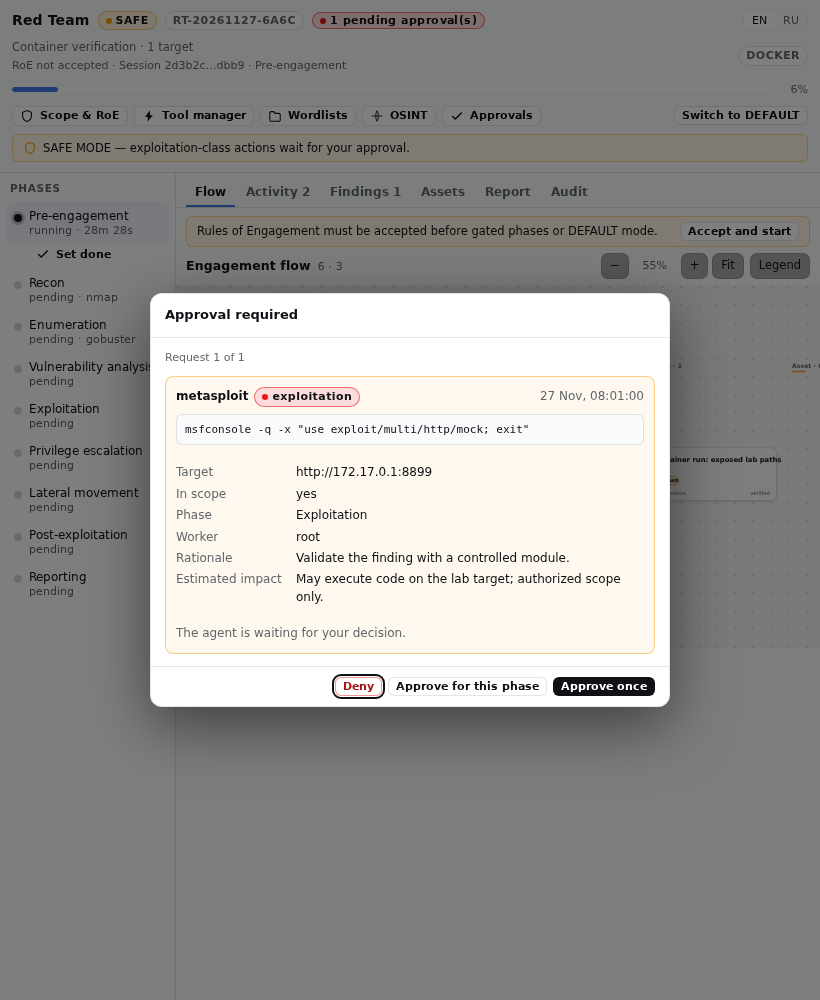
DEFAULT mode runs the full chain; optional SAFE mode gates six exploitation-class categories behind a card with the exact command, target, phase and impact. Ignoring it expires the request after five minutes — nothing defaults to approved. The bounded loop in pentest_exploitation respects the same decision: a denial ends the loop, it is never retried around.
pentest_exec blocks·pentest_exploitation·pentest_approvals06 Host · graph + evidence
Facts and findings enter the Goal → Intent → Fact → Finding → Asset graph and cite the run that produced them. Tool output, screenshots and HTTP exchanges are captured write-once, hashed with SHA-256, and linked to the node they prove. OSINT enrichment adds sourced, dated facts and a provenance map, and pentest_osint_report renders them as a standalone brief. Blind callbacks from pentest_oob canaries and evidence-only verdicts from pentest_verify land in the same chain.
pentest_add_fact·pentest_add_finding·pentest_osint_enrich·pentest_osint_report·pentest_evidence_add·pentest_attach_evidence·pentest_oob·pentest_verify07 Host · reporting
pentest_report produces a draft in any of six formats, DOCX included. The HTML deliverable is a findings-first brief: verdict, severity mix, business issues linked to their finding cards, and technical detail behind a per-finding expander that opens automatically for print. pentest_complete_engagement refuses while a non-reporting phase is neither done nor skipped with a reason, then writes the final set in English or Russian; pentest_sarif exports findings as SARIF 2.1.0 and pentest_export_bundle adds the whole project as one deterministic ZIP. If the work must stop early, Stop keeps the record and Restart archives it before a clean start.
pentest_report·pentest_complete_engagement·pentest_sarif·pentest_export_bundleScope and the Rules of Engagement are operator actions; every other step runs in the Host and is audited before the result comes back. Click any step to take over — Play resumes the loop.
The panel
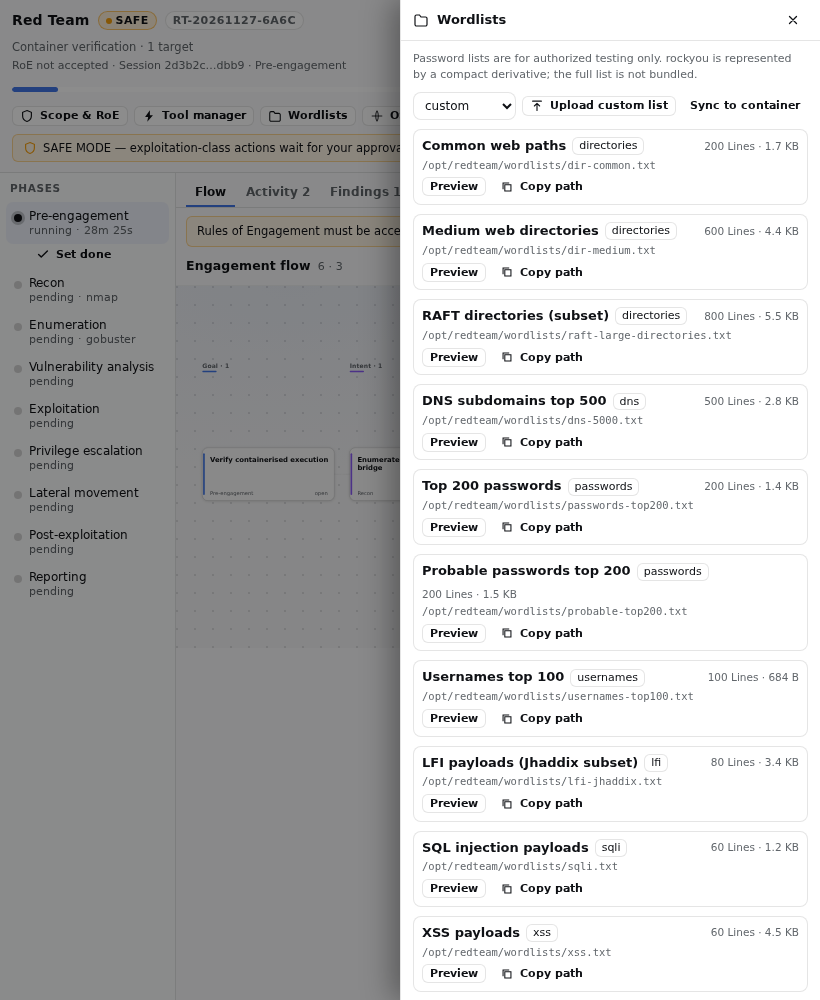
It docks like any other sidebar tab: drag, split, float, fullscreen, resize — with light, dark and system appearance, English and Russian. Since 1.2 the strip carries Team (plan, roles, budgets and QC); since 1.3 it also carries OSINT, the read-only board for enrichment results and the standalone report. The Flow, OSINT and Assets captures below were taken on the 1.2 and 1.3.0 builds; the drawer captures — Tool manager, Evidence, API test, Approval and Wordlists — are older 1.0/1.1 images kept until a safe newer capture exists. Each caption says which build it shows.
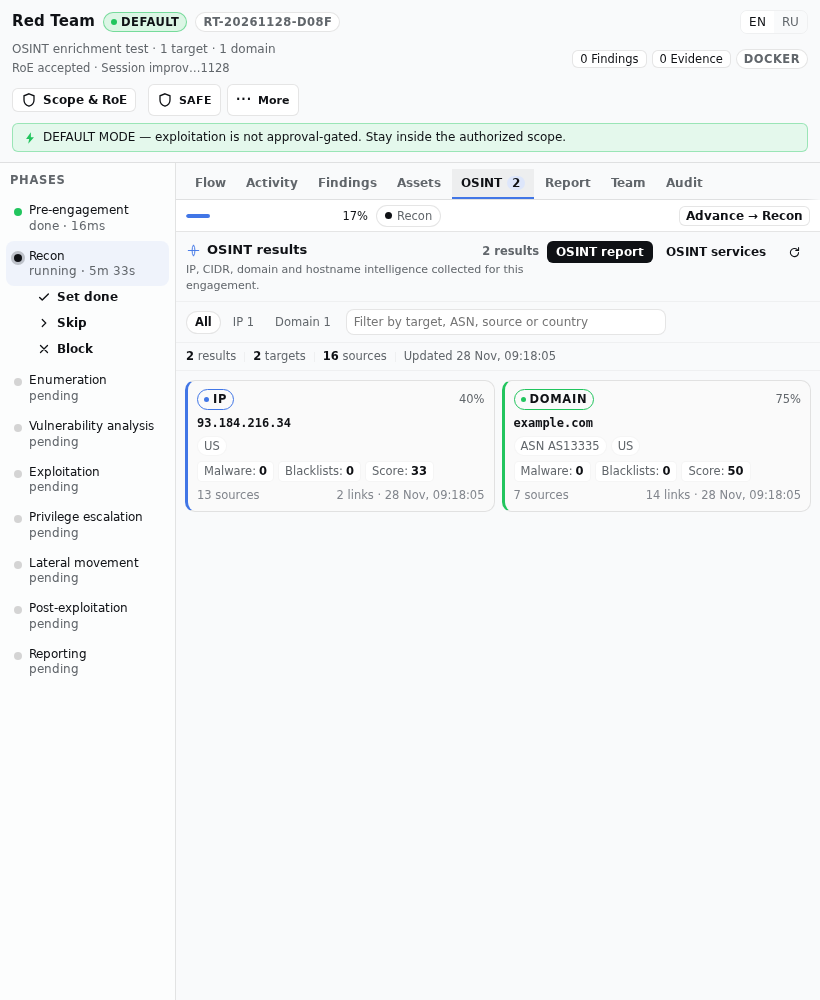
example.com test; the rows are demo fixtures.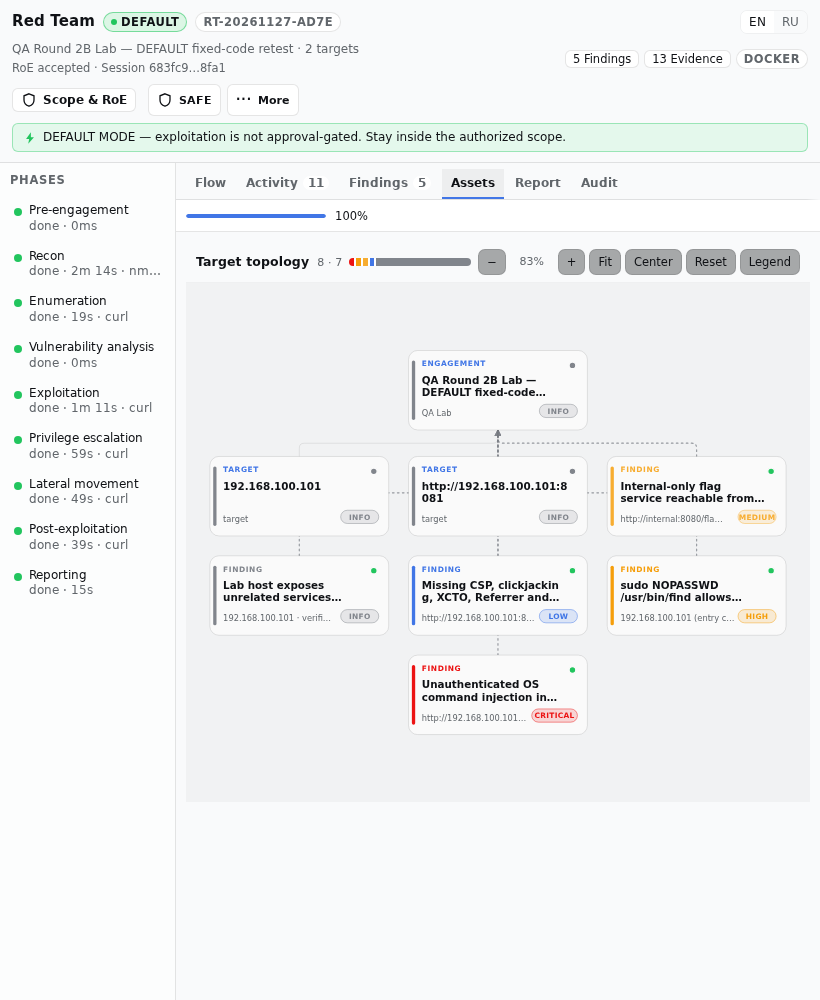
Agent surface
Engagement and graph, a bounded exploitation loop, execution and toolbox, wordlists, web/API/scanning, evidence and export, verification and proof, planning and team, and knowledge with the OSINT layer. Every call resolves the engagement, checks the Rules of Engagement, validates scope, classifies the tool category and writes an audit entry.
start_engagement scope state graph add_goal add_intent add_fact add_asset add_finding set_phase update_engagement identity complete_engagement
exploitation — plan, record a real attempt, delegate or read status
exec setup_toolbox tool_inventory install_tool remove_tool tool_search
wordlists resolve_wordlist enhance_wordlist wordlist_feedback wordlist_adapt
browser web_assess api_discover api_request api_fuzz nuclei
evidence_list evidence_add evidence_get evidence_package attach_evidence export_bundle sarif
verify retest oob
plan team
osint osint_enrich osint_report methodology skills report approvals audit
Safety model
DEFAULT is the install default and runs the full PTES chain. SAFE is the opt-in gate: exploitation-class commands then wait for an operator decision. In both modes, scope, operator-only RoE acceptance, append-only audit, hashed evidence and inert, engagement-scoped canaries always apply.
rt-… token and only records hits reported to the local canary route; it opens no listener and sends no traffic. A target attached to a canary must be inside the accepted scope, hits are deduplicated and bounded, and the canary expires by default after an hour.Documentation
Twelve chapters, install to hand-off: scope, phases, approvals, web and API testing, evidence, reports and the bundle.
StartRequirements, install, Docker access, upgrade, uninstall and backup.
SetupEvery key, its default, validation range and environment variable — nothing has to be set.
GuideEvery tab and drawer, the approval lifecycle, and four end-to-end workflows.
ReferenceAll 53 tools with parameters, gates and side effects.
SecurityModes, approvals, scope rules, audit, evidence integrity and egress.
InternalsHost and client halves, data model, HTTP bridge and the nine invariants.
DoctrineThe 20 playbooks, their phases, evidence requirements and ATT&CK/WSTG references.
OSINTThe 39 connectors, passive enrichment pipelines, standalone report, key resolution, leak and dark-web gates.
ExploitationCandidate sources, attempt classification, caps, evidence contract and the delegation roles.
ReportingThe six formats, DOCX structure, embedded evidence and the findings-first HTML brief.
OperationsDocker, Chromium, expired approvals and how to recover a session that is stuck.
WikiQuick start, panel tour, Kali toolbox, wordlists, OSINT, troubleshooting and FAQ.
Field notes — long-form articles on the design and the trade-offs →

Developer
Offensive security · AI & automation engineering
CEH-certified security engineer with 15+ years in IT and a decade in offensive security: penetration testing, compliance audits (PCI DSS, ISO 27001, SOC 2, GDPR) and AI agent engineering. dsh-redteam is built from that practice — the engagement model, the gates and the evidence chain are what a real assessment needs.